Low P/E Stocks: Hidden Gems or Clever Traps?

Low P/E Stocks

For anyone walking the value-investing path, few numbers are as tempting as a low P/E ratio. A stock trading at 8x or 10x earnings feels like a clearance sale. The business is earning money, yet the market seems uninterested. Surely this is where fortunes are made?

Sometimes, yes. But just as often, low P/E stocks are cheap for a reason  and that reason can quietly destroy capital. Understanding why a P/E is low matters far more than how low it is. Let’s slow down, strip away the noise, and look at low P/E stocks the way a patient investor should.

What the P/E Ratio Really Tells You

At its simplest, the Price-to-Earnings (P/E) ratio tells you how much the market is willing to pay for one rupee of a company’s earnings.

P/E = Market Price Ă· Earnings Per Share

A P/E of 10 means investors are paying ₹10 for every ₹1 the company earns.

Traditionally:

  • Low P/E = cheap, unloved, possibly undervalued 
  • High P/E = expensive, popular, growth expectations baked in

But here’s the uncomfortable truth most beginners learn the hard way:

The P/E ratio doesn’t tell you whether earnings will survive.

And that’s where things get interesting  and dangerous.

Why Low P/E Stocks Look So Attractive

Low P/E stocks pull value investors in because they promise asymmetry  limited downside, large upside.

The thinking goes like this:

  • The business is already profitable
  • Expectations are low
  • Even a small improvement could re-rate the stock

And sometimes, that thinking is spot on.

When Low P/E Stocks Are Genuine Opportunities

1. Market Overreaction 

Markets are emotional creatures. Bad news  quarterly misses, regulatory headlines, macro fears  often push prices down faster than fundamentals deteriorate. In such moments, quality businesses can trade at low P/Es temporarily. Investors who bought strong banks or FMCG companies during crisis periods didn’t do anything clever  they simply stayed rational when the market panicked.

2. Cyclical Lows (Not Peaks)

Cyclical businesses move in waves. Steel, oil, chemicals, automobiles  profits swing wildly based on economic conditions. A cyclical stock trading at a low P/E during a downturn can be a gift  because earnings are depressed, not inflated. Timing matters here. Buying cyclicals at the bottom of the cycle is value investing. Buying them at the top is how people get trapped.

3. Boring but Predictable Businesses

Some businesses never make headlines. They don’t promise disruption or exponential growth. Yet they quietly generate cash year after year.

Utilities, consumer staples, mature retail chains  these often trade at modest P/Es simply because they’re boring. Over time, dividends and steady compounding do the heavy lifting.

How Low P/E Ratios Fool Investors

Now for the harder part. Many low P/E stocks aren’t bargains  they’re warnings. Here’s how they fool even experienced investors.

1. The Cyclical Peak Illusion

This is one of the most common traps.

  • A cyclical company reports record profits.
  • Margins expand dramatically.
  • EPS shoots up.
  • P/E collapses.

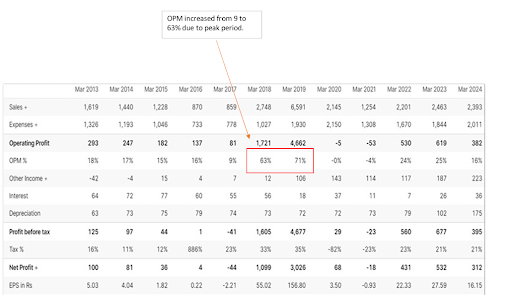
The stock suddenly looks cheap  but earnings are at their peak, not normal. Take cases like graphite electrode manufacturers during supply shortages. Operating margins jumped from single digits to 60–70%. Earnings exploded. P/E ratios collapsed. But when supply normalised, margins vanished. Earnings fell.

And the “cheap” stock wasn’t cheap anymore it was priced for peak profits that never returned. Low P/E caused by peak earnings is not undervaluation. It’s an illusion.

2. One-Time Gains Dressing Up Earnings

Sometimes earnings look strong  but only on paper.

  • Asset sales
  • Tax benefits
  • Accounting adjustments

These inflate net profit temporarily, dragging the P/E down. If you don’t strip out these one-offs, you’re valuing a business on earnings that won’t repeat. Cash flow usually exposes this lie faster than profit & loss statements.

3. Declining Businesses Wearing a Cheap Label

A shrinking business often looks cheap right before it becomes irrelevant.

  • Revenue stagnates.
  • Margins erode.
  • Competition intensifies.

The market senses this before the financials collapse  and prices the stock accordingly. Cases like Café Coffee Day tell this story well.
Once commanding high P/E multiples, the business slowly lost relevance. As profits declined and losses mounted, the P/E compressed  not because value emerged, but because confidence disappeared.

A low P/E cannot revive a broken business model.

4. Debt Makes Cheap Stocks Dangerous

Debt changes everything.

A leveraged company might look optically cheap until interest costs eat into earnings or refinancing becomes difficult. During downturns, debt doesn’t just reduce upside  it threatens survival. Many energy and infrastructure stocks learned this lesson brutally during commodity crashes. A low P/E with high debt is not value  it’s leverage disguised as opportunity. A classic Indian example of this trap is HEG Ltd.
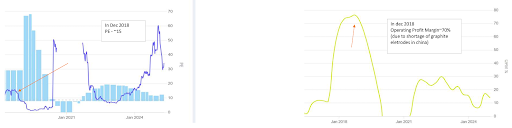
In 2017–18, a global shortage of graphite electrodes driven largely by environmental shutdowns in China sent prices soaring. HEG’s operating margins exploded from single digits to over 60%, and profits followed. On the surface, the stock looked absurdly cheap, with the P/E ratio collapsing to seemingly “bargain” levels.

But those earnings were peak-cycle earnings, not normalised ones. As supply returned and prices cooled, margins reverted, profits fell sharply, and the low P/E that once looked attractive revealed itself as an illusion. Investors who bought purely on valuation learned a hard lesson about confusing cyclical peaks with sustainable profitability.


High P/E Can Fool You Too

Interestingly, the reverse also happens.

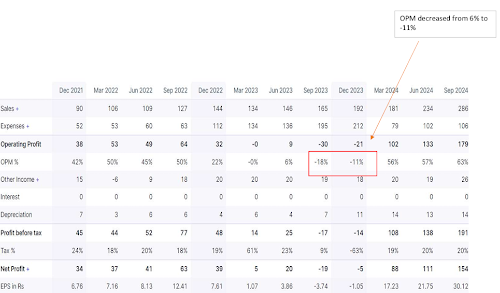
A high P/E doesn’t always mean overvaluation. Cyclical stocks during downturns often show absurd P/E ratios because earnings collapse temporarily. In such cases, high P/E reflects depressed earnings, not expensive prices. This is why relying on P/E alone — low or high  without context leads to bad decisions. In FY23–24, MCX reported sharply lower profitability due to one-time technology transition costs and regulatory uncertainty.

Operating margins turned negative, earnings collapsed, and the P/E ratio shot up to eye-watering levels making the stock look outrageously expensive on the surface.

But the elevated P/E wasn’t a reflection of an overpriced stock; it was the result of temporarily depressed earnings. As operational stability returned and volumes normalised, profitability improved and the valuation started making far more sense in hindsight. A low P/E ratio isn’t an answer it’s a starting point.
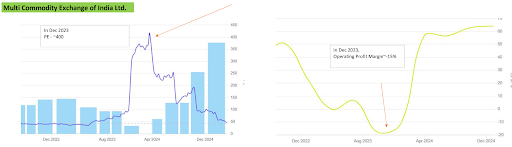
Sometimes it reflects fear or temporary disruption, creating real opportunities. Other times, it hides peak-cycle earnings or structural decline, turning “cheap” stocks into value traps. Examples like HEG and MCX show that valuation only makes sense when viewed in context.

Good investing isn’t about buying low P/E stocks or avoiding high ones. It’s about understanding why a stock is priced the way it isand whether its earnings are sustainable. In the end, numbers don’t create value.
Durable businesses do.

DuPont Analysis: Why a High ROE Can Be a Trap (And How Smart Investors See Through It)

A high Return on Equity (ROE) is often treated like a badge of honor in investing. A company showing 20–25% ROE immediately looks attractive. But here’s the uncomfortable truth: ROE alone can lie.

Two companies can report the same ROE and yet be worlds apart in quality and risk. One may be a genuinely strong business with pricing power and disciplined operations. The other may simply be using heavy debt to manufacture returns.

So how do you separate real performance from financial engineering?

That’s where DuPont Analysis comes in.

This nearly century-old framework breaks ROE into its core drivers, allowing investors to understand how returns are generated—and whether those returns are sustainable.

The Problem With Looking at ROE in Isolation

ROE is calculated as:

ROE = Net Income ÷ Shareholders’ Equity

Simple. Clean. Dangerous.

Imagine two companies:

  • Company A earns ₹100 crore on ₹500 crore of equity with little or no debt.
  • Company B earns the same ₹100 crore on ₹500 crore of equity—but carries ₹2,000 crore of debt.

Both show a 20% ROE.

Only one deserves your capital.

ROE doesn’t tell you how profits were achieved. DuPont Analysis does.

What Is DuPont Analysis?

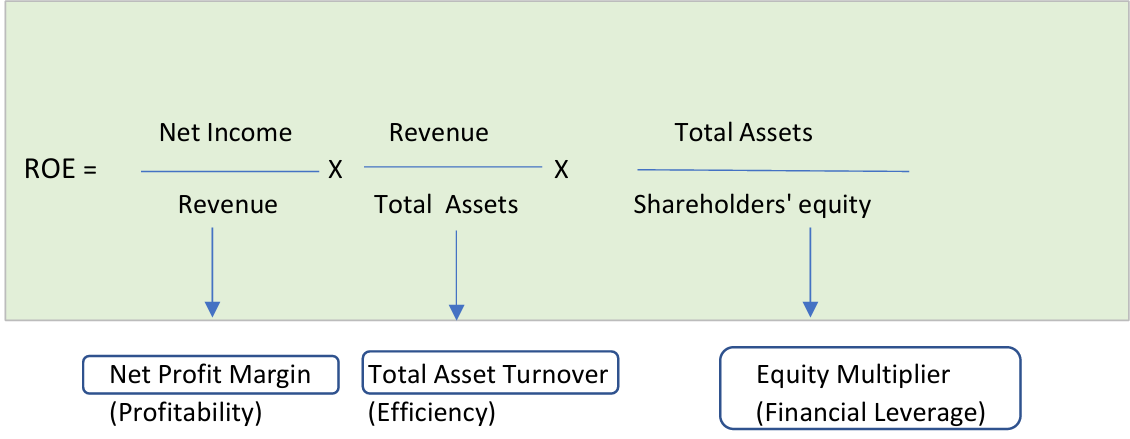
DuPont Analysis decomposes ROE into three fundamental business drivers:

ROE = Profit Margin Ă— Asset Turnover Ă— Financial Leverage

Each component answers a different question:

  • Profit Margin – How much profit is made from each rupee of sales?
  • Asset Turnover – How efficiently are assets used to generate revenue?
  • Financial Leverage – How much debt is being used to boost returns?

Together, these reveal whether ROE is coming from business strength or balance-sheet risk.

The Three Drivers of ROE (Explained Simply)

1. Profit Margin: The Quality of Earnings

Formula:
Net Profit Margin = Net Income Ă· Revenue

This shows how much of each rupee earned actually turns into profit. High margins usually signal strong pricing power, cost discipline, or a competitive moat.  Companies like FMCG leaders or IT services firms often score high here. If margins are thin, the business has very little room for error.

2. Asset Turnover: How Hard the Business Works Its Assets

Formula:
Asset Turnover = Revenue Ă· Total Assets

This measures efficiency. Some businesses operate on thin margins but compensate by selling large volumes quickly. Retailers like DMart thrive on high asset turnover. Capital-heavy businesses such as infrastructure or utilities naturally score lower but that’s not a flaw, it’s a business model reality.

3. Financial Leverage: The Risk Multiplier

Formula:
Equity Multiplier = Total Assets ÷ Shareholders’ Equity

This shows how much debt is being used to generate returns. Leverage amplifies ROE—but also magnifies losses. A leverage ratio of 1 means no debt. A ratio of 5 means 80% of assets are funded by borrowing. High leverage doesn’t mean “bad,” but it demands caution.

DuPont Analysis: Britannia Industries Ltd. (FY2025)

Using the DuPont framework, Britannia’s Return on Equity (ROE) for FY2025 can be broken down as follows:

Interpretation of Key Drivers

1. Net Profit Margin – 12.14%

Britannia earns approximately ₹12.14 in profit for every ₹100 of revenue, reflecting strong pricing power, cost discipline, and operational efficiency.
In a competitive FMCG environment where margins are often under pressure this level of profitability highlights the strength of Britannia’s brand portfolio and execution.

This is quality ROE, driven by real operating performance, not accounting leverage alone.

2. Asset Turnover – 2.0x

An asset turnover of 2.0x means Britannia generates ₹2 of revenue for every ₹1 invested in assets.
This indicates an asset-light, high-efficiency business model, typical of well-run FMCG companies that rely on strong distribution networks and rapid inventory movement rather than heavy fixed assets.

Britannia sweats its assets hard a hallmark of scalable consumer businesses.

3. Equity Multiplier – 2.16x

The equity multiplier shows that Britannia uses moderate financial leverage, with assets funded by a mix of equity and debt.
While leverage does amplify returns, Britannia’s level is controlled rather than aggressive, especially compared to capital-intensive sectors.

What This Tells a Long-Term Investor

  • âś” Strong profitability: Reflects brand strength and cost control
  • âś” Efficient asset utilization: Indicates operational excellence
  • âś” Balanced leverage: Enhances returns without materially increasing risk

The 5-Step DuPont Analysis: A Deeper Look at ROE

While the traditional DuPont Analysis breaks ROE into three drivers, the 5-step DuPont model goes one level deeper. It separates the impact of taxes and interest costs, allowing investors to pinpoint whether returns are being affected by tax efficiency, debt structure, or core operations.

This version is especially useful when comparing companies with different capital structures or tax profiles.

1. Tax Burden (A)

Formula: Net Income Ă· EBT
What it shows: How much profit remains after tax.

A higher ratio indicates tax efficiency or a stable tax regime. A lower ratio may reflect higher effective tax rates or loss of tax benefits.

2. Interest Burden (B)

Formula: EBT Ă· EBIT
What it shows: Impact of interest costs on profitability.

A ratio close to 1 means low interest pressure. A falling ratio indicates that debt servicing is eating into operating profits.

3. Operating Profit Margin (C)

Formula: EBIT Ă· Revenue
What it shows: Core operating strength before financing and taxes.

This is the purest measure of business quality—pricing power, cost control, and operating leverage.

4. Asset Turnover (D)

Formula: Revenue Ă· Total Assets
What it shows: How efficiently assets are used to generate sales.

High turnover businesses rely on volume and speed, not heavy margins.

5. Equity Multiplier (E)

Formula: Total Assets ÷ Shareholders’ Equity
What it shows: Degree of financial leverage.

Higher leverage boosts ROE—but also increases financial risk.

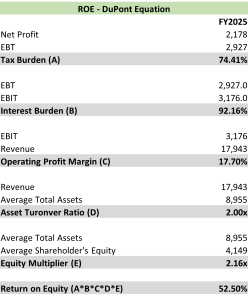
5-Step DuPont Analysis: Britannia Industries Ltd. (FY2025)

Interpretation: What the 5-Step Model Reveals

  • âś” Operating strength is the real driver – An 18% EBIT margin combined with 2.0x asset turnover confirms that Britannia’s ROE is primarily driven by business fundamentals, not financial engineering.
  • âś” Minimal stress from interest costs – An interest burden of 92% shows that most operating profit flows through to pre-tax profits. Debt is present, but it is not distorting returns.
  • âś” Tax efficiency is stable, not aggressive – A tax burden of 74.4% suggests Britannia is not relying on tax arbitrage to inflate ROE. Returns are clean and repeatable.
  • âś” Leverage enhances, not manufactures ROE – With an equity multiplier of 2.16x, leverage plays a supporting role, unlike highly indebted businesses where leverage becomes the main ROE driver.

3-Step vs 5-Step DuPont: Why Both Matter

  • 3-Step DuPont tells you where ROE comes from
  • 5-Step DuPont tells you why it comes from there

ROE is a powerful metric—but only if you understand what’s behind it. On its own, it hides more than it reveals. DuPont Analysis breaks ROE into its true drivers, helping investors see whether returns come from strong operations, efficient asset use, or financial leverage.

The 5-step model goes even deeper, separating the impact of taxes and interest to reveal the real quality of earnings. Britannia’s FY2025 performance shows what high-quality ROE looks like—driven by operating strength and efficiency, not excessive debt.

The takeaway is simple: don’t just look at ROE, dissect it. Long-term wealth is built by understanding how returns are earned, not by chasing impressive numbers.